Cleaning Business Growth
How to Price a House Cleaning Job in the US (2026 Pricing Guide)
Learn how to price a house cleaning job in the US using 2026 hourly ($30–$80/hr), flat-rate ($140–$220), and square-footage ($0.10–$0.20/sq ft) benchmarks. Includes a step-by-step 2,000 sq ft quote walkthrough, labor and overhead formulas, and how to automate online estimates with Opygen Clean.
Faysal Mridha10 min read
How to Price a House Cleaning Job in the US (2026 Pricing Guide)
Pricing a house cleaning job in the United States comes down to a simple tension: quote too high and the homeowner books someone else; quote too low and you spend four hours scrubbing baseboards for less than minimum wage once drive time, supplies, and taxes come out. According to Angi's 2026 Professional House Cleaning Cost Report, the national average for a standard residential visit sits at $176 (typically ranging from $118 to $238), while Housecall Pro's 2026 House Cleaning Pricing Guide places standard 3-bedroom home visits between $140 and $220.
Knowing the national average is helpful, but averages do not pay your crew on Friday. To build a profitable cleaning business—whether you are a solo cleaner quoting your first apartments or a growing agency managing multiple teams on Opygen Clean—you need a repeatable pricing formula based on labor hours, true overhead, and clear scope boundaries.
This guide breaks down the three ways US cleaning companies price residential jobs in 2026, gives you the exact math for a 2,000-square-foot house, and shows you how to turn your pricing rules into an automated online booking page.
2026 US House Cleaning Rates at a Glance
Before choosing a pricing model, check where your rates sit against current US market bands. Data compiled from Housecall Pro's 2026 Pricing Benchmarks, Eufy's 2026 Home Cleaning Price Insights, and Pro Housekeepers' 2026 Pricing Guide shows the following typical ranges across the US:
Pricing Method / Service Type | 2026 US Typical Range | National Midpoint / Benchmark | Best Used For |
Hourly Rate (Per Cleaner) | $30 – $80 / hr | $45 – $55 / hr | First-time jobs, cluttered homes, new solo cleaners |
Standard Clean (Flat Visit Rate) | $100 – $250 / visit | $176 / visit | Recurring weekly, biweekly, or monthly maintenance |
Deep Clean (First-Time / Seasonal) | $200 – $450 / visit | $300 / visit | First visit before recurring service or spring reset |
Move-In / Move-Out Clean | $250 – $550 / visit | $380 / visit | Empty homes, end-of-tenancy handovers, real estate listings |
Per Square Foot (Standard) | $0.10 – $0.20 / sq ft | $0.15 / sq ft | Cross-checking quotes on homes over 2,500 sq ft |
Per Square Foot (Deep / Move-Out) | $0.20 – $0.35 / sq ft | $0.25 / sq ft | Large homes with heavy buildup or inside-appliance work |
The 3 Ways to Price a House Cleaning Job (And When to Use Each)
Most successful US cleaning agencies do not stick to a single pricing method forever. Instead, they combine three methods depending on the job type and how predictable the home is.
1. Hourly Pricing ($30 to $80 Per Labor Hour)
With hourly pricing, you charge a fixed rate for every hour each cleaner is on-site. According to Housecall Pro's 2026 US customer data, professional cleaners typically bill between $30 and $80 per hour per cleaner, meaning a two-person crew billing $45 per cleaner costs the client $90 per clock hour.
Hourly pricing protects your margin when a home's condition is unpredictable—such as a post-party cleanup, a neglected home, or an organizing add-on (Pro Housekeepers notes that standalone organizing commonly bills at $75 per hour). The downside is that homeowners dislike open-ended bills, and as your cleaners get faster with better checklists and equipment, hourly billing actually pays you less for finishing early.
2. Flat-Rate Pricing by Bedroom and Bathroom ($100 to $300+)
Flat-rate pricing is the standard for modern residential cleaning companies because clients know the exact total before they book. You set a base price by bedroom and bathroom count—plus the home's approximate square footage—and adjust for frequency.
Based on Eufy's 2026 US Bedroom Rate Breakdown and HomeAdvisor's 2026 Cleaning Service Cost Guide, flat rates for a standard maintenance clean typically follow this progression:
Studio or 1-Bedroom / 1-Bathroom (under 1,000 sq ft): $85 to $140 per visit
2-Bedroom / 2-Bathroom (1,000 to 1,500 sq ft): $120 to $200 per visit
3-Bedroom / 2- to 2.5-Bathroom (1,600 to 2,200 sq ft): $150 to $260 per visit
4-Bedroom / 3+ Bathroom (2,500 to 3,500+ sq ft): $220 to $400+ per visit
When you configure an online booking page in Opygen Clean, flat-rate rules let homeowners select their home size, pick their date, and pay upfront via Stripe at 10:00 PM on a Sunday without waiting for you to text back an estimate.
3. Per-Square-Foot Pricing ($0.10 to $0.35 Per Sq Ft)
Charging by the square foot is the fastest way to sanity-check a quote on a large residence. As reported by Angi's 2026 Pricing Guide and GetQuotePro's 2026 Cleaning Rate Guide, standard residential cleans run $0.10 to $0.20 per square foot, deep cleans run $0.15 to $0.25 per square foot, and intensive move-out cleans reach $0.25 to $0.35 per square foot.
Use square footage as a guardrail rather than your only formula. A 3,200-square-foot home with two retired adults and guest rooms that never get used takes far less labor than a 1,800-square-foot house with three kids and two shedding dogs.
Step-by-Step Formula: How to Calculate Your Exact Quote
Never pull a flat rate out of thin air or copy a local competitor's price list without knowing your own cost floor. Use this four-step formula from Cleaning Cost Calculators' 2026 Margin Framework and Housecall Pro to price any house in under five minutes.
Step 1: Estimate Total Labor Hours (Production Rate)
An experienced residential cleaner typically completes 500 to 700 square feet per hour on a standard maintenance clean, or 300 to 400 square feet per hour on a detailed deep clean.
For a 2,000-square-foot, 3-bedroom, 2.5-bathroom home:
Standard clean: 2,000 sq ft ÷ 550 sq ft/hr = 3.6 labor hours (call it 3.5 to 4 hours for one cleaner, or 1.75 to 2 hours for a two-person team).
First-time deep clean: 2,000 sq ft ÷ 330 sq ft/hr = 6.0 labor hours (3 hours for a two-person team).
Step 2: Calculate True Labor Cost (Base Wage + Payroll Burden)
If you pay a W-2 cleaner $22.00 per hour, that cleaner actually costs your business roughly 25% to 30% more once you include employer FICA taxes (7.65%), federal and state unemployment (FUTA/SUTA), paid drive time between houses, and workers' compensation insurance (which averages $114 to $135 per month per Insureon's 2026 Cleaning Insurance Report and MoneyGeek's 2026 Cleaning Insurance Study).
Base hourly wage: $22.00 / hr
30% labor burden: $6.60 / hr
True loaded labor cost: $28.60 per labor hour
For a 3.75-hour standard clean: 3.75 hours × $28.60 = $107.25 in direct labor
Step 3: Add Supplies and Operating Overhead (15% to 20%)
Every visit consumes microfiber cloths, vacuum maintenance, eco-friendly sprays, trash liners, fuel, general liability insurance ($51 to $59/month median per Insureon), software, and payment processing fees (around 2.9% + $0.30 on card payments).
Across a well-run 3-to-10-cleaner agency, supplies and fixed overhead typically absorb 15% to 18% of revenue (roughly $25 to $35 on a standard house clean).
Direct labor (3.75 hrs): $107.25
Supplies + overhead allocation: $30.00
Break-even cost to open the client's front door: $137.25
Step 4: Add Your Target Net Profit Margin (20% to 30%)
To grow your business, replace vehicles, and pay yourself as an owner, aim for a 25% to 30% net profit margin above your break-even cost.
Formula: Break-Even Cost ÷ (1 − Target Margin)
Calculation: $137.25 ÷ (1 − 0.28) = $190.62 (round to $190 or $195 for a one-time standard clean).
Notice how that $190 figure lands right inside Housecall Pro's $140–$220 benchmark and Angi's $176 national average—except now you know for a fact that $53 of that $190 is true net profit.
How to Structure Recurring Discounts Without Losing Margin
Recurring clients—weekly, biweekly (fortnightly), and monthly—are the lifeblood of a cleaning company. Because your crew cleans the same house repeatedly, soap scum and dust never build up to first-visit levels, cutting on-site labor time by 15% to 25% after the initial deep clean.
Per HomeAdvisor's 2026 Weekly Cleaning Data, you should reward frequency with structured tiers anchored against your first-time deep clean:
First-Time Deep Clean (Required for new recurring clients): $310 (6 labor hours)
Weekly Recurring Rate (20% off base standard rate): $155 per visit ($620/month)
Biweekly / Fortnightly Rate (10% to 15% off base standard rate): $170 per visit ($340/month)
Monthly / Every 4 Weeks Rate (Full standard rate): $195 per visit
Never discount the first clean in hopes that a client will stay for recurring service. Require a full-price initial deep clean to bring the home up to your company standard, then lock in the recurring schedule automatically inside Opygen Clean's Recurring Bookings module.
High-Profit Add-On Menu (Protect Your Scope)
The fastest way to lose money on a flat-rate job is letting "standard clean" mean different things to the homeowner and the cleaner. Keep your base price competitive and charge flat add-on fees for high-time tasks using 2026 US Add-On Benchmarks:
Inside Refrigerator (empty & sanitize): +$35 to $50 (adds 30–45 mins)
Inside Oven (degrease racks & glass): +$40 to $55 (adds 30–45 mins)
Inside Kitchen & Bathroom Cabinets (empty): +$45 to $65 (adds 45–60 mins)
Interior Windows & Tracks: +$5 to $8 per window
Wet-Wiping Baseboards / Skirting Boards Throughout: +$35 to $60 (included in Deep Clean, add-on for Standard)
Heavy Pet Hair / Multi-Pet Fee: +$25 to $45 per visit
Wash, Dry & Fold 1 Load of Laundry: +$25 to $35
3 Pricing Mistakes That Quietly Kill Cleaning Businesses
Even when owners get the base math right, three operational habits drain profit at the end of the month:
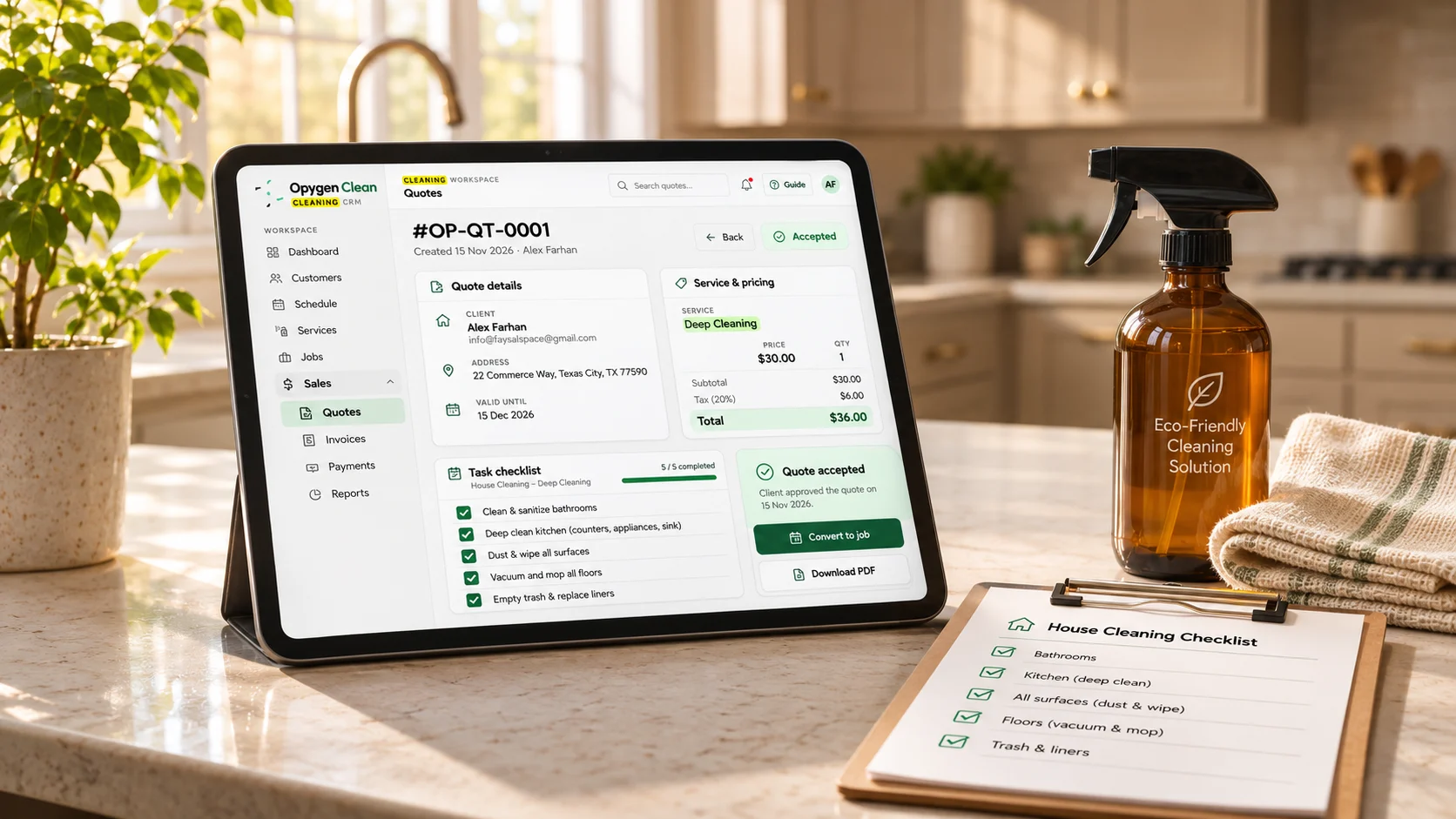
Quoting over text without a checklist: When you text a client "$160 for Friday" without attaching a checklist, the client expects the inside of their oven and blinds cleaned. Attaching a digital room-by-room checklist to every job stops scope creep before the crew arrives.
Chasing checks and Venmo after the clean: If you spend three hours every Sunday texting clients about unpaid $180 invoices, your hourly profit drops. Requiring card details at booking and sending an automated PDF invoice the moment the booking is confirmed eliminates overdue accounts.
Not tracking expenses by category: You cannot know if your $190 quote is truly profitable if chemical supplies, mileage, staff wages, and Stripe fees live in separate bank statements and spreadsheets.
Turn Your Pricing Rules Into a 24/7 Booking System
Once you set your base rates, frequency discounts, and add-on prices, you should not have to calculate them by hand on your phone between jobs.
With Opygen Clean, you can plug your flat-rate or hourly pricing rules directly into a branded online booking page in minutes:
Online Booking & Instant Quotes: Clients select their bedrooms, bathrooms, cleaning type, and add-ons 24/7, and pay upfront via Stripe.
Automated PDF Invoicing: Invoices are generated and emailed the moment a booking is confirmed—with real-time tracking for paid, overdue, and cancelled invoices.
Checklists & Staff Dispatch: Attach your standard vs. deep-clean checklist to the job so your cleaners see the exact scope on their phones—no group chats, no missed baseboards.
Live Net Profit & Expense Tracking: Log staff wages, equipment, vehicle costs, marketing, and insurance in one dashboard so you see your real profit margin on every clean.
Ready to replace spreadsheets and manual quotes with one connected system? Start your 7-day free trial of Opygen Clean today—no credit card required, with plans starting at $49/month for up to 3 staff members.